 |
 |
 |
 |
 |
 |
 |
 |
|
|
AMERICAN FOOTBALL MONTHLY THE #1 RESOURCE FOR FOOTBALL COACHES

Article CategoriesAFM Magazine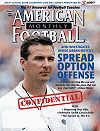
|
The Secrets of Urban Meyer\'s Spread Option Offenseby: Terry Jacoby© More from this issue 
The legend lives on: From the flat lands of northern Ohio to the depths of Salt Lake City to the swamps of Florida, Urban Meyer, at the young age of 41, has already earned the moniker of legend. He has been called a football genius, an offensive innovator and is considered the architect behind an offense that even the best minds in college football can’t harness, let alone stop. His spread option offense helped change the game and in turn brought respectability to Bowling Green, an undefeated season to Utah and renewed success for the Florida Gators. Meyer certainly brought with him plenty of impressive credentials, including a two-time National Coach of the Year. And with the help of Meyer, his Offensive Coordinator Dan Mullen and a few guys paid to try and stop this offense, we will take an inside look at the legend’s offense, how it works and why it works. Defining Meyer’s spread option It’s called a few different things, but essentially Urban Meyer’s offense is known in football circles as a spread option. The philosophy is quite simple. Meyer and company spread out the offense and force you to defend from sideline to sideline, using the entire width of the field to their advantage. The more space a defense has to cover, the more room it creates for Florida’s outstanding athletes. Once you’re spread out, they then let you decide what it is you are going to stop, the run or the pass, and they burn you with the other. “All things being equal, anybody can stop the run and anybody can stop the pass,” Meyer said. “But can you stop both?” Meyer likes his quarterback in the shotgun. In fact, the quarterback in this offense is almost always in the shotgun. Behind him is usually just one running back, sometimes none. The four or five wide receivers are constantly in motion, trying to create confusion for the defense and find that perfect mismatch in talent or opening in the defense that they then can exploit. “I consider it a split-back veer offense except they are in the shotgun,” said Air Force Academy Defensive Coordinator Richard Bell. “The biggest difference is that most option teams have a tight formation, but the thing that made it difficult was that you never had to defend four wide receivers or a three-by-one set with three receivers to one side. You now had to deal with the width of the receivers and being able to defend the pass as well as the run and that’s what made it very, very difficult.” By creating space with the spread offense, Meyer is able to open up serious running lanes. And because of the threat of the run, especially the option, the use of misdirection and the often times quick and short pass routes, defenses don’t have time to blitz, let alone adjust. Defenses can’t get overly aggressive or the play could be behind them or going the other way in an instant. “And everybody, including Urban, is always putting in new things and gotten better and better at running it,” Bell said. “Now they have a trap game off it and a counter game off of it. You have to be sound in every aspect of the running game to be able to stop it.” Mix in some old-school option football, short, high-percentage passes with the new triple-option and spread it out across the width of the football field with superior athletes and you have the Urban Meyer offense. And if you think trying to define it is difficult, try to stop it. “It’s an excellent offense, but it still comes down to execution, whether you’re running it or trying to stop it,” said a prominent Defensive Coordinator who did not want to be identified. “One of the things (Steve) Spurrier used to do (at Florida) is that when he split you out, you had to move someone out with him and he felt like he was blocking a guy by spreading him out. To a degree, that’s true. There are some differences between what (Meyer) is doing and what Spurrier was doing, but there also are some similarities as well. The spread offense forces you to make plays in space a little bit more than other offenses.” Balance One of the reasons Meyer’s spread offense has been successful is because it helps create space to run the football. Yes, despite what the blogs and message boards and radio talk show hosts say, Urban Meyer’s offense is about running the football. “One of the biggest misconceptions that defensive coordinators have about our offense is that they look at our offense and believe that we want to throw the ball a lot,” Mullen said. “The opposite is true though. We’d rather run than throw.” The statistics back it up. Last year, Florida ran the football 455 times for 2,167 yards and passed 385 times. The team’s leading rusher was DeShawn Wynn, who led the team with 130 carries. But right behind him was quarterback Chris Leak, who threw 374 times and ran 105 times. “Our optimal run to pass ratio is 50/50 each time we take the field,” Mullen said. “It’s a very, very strong running offense and when we faced it, (Utah) had some very good running backs and they did a lot of things off of it,” Bell said. “You have to be sound on who is going to take the quarterback and who is going to take the dive and the pitch or they will certainly burn you. It’s a lot more than a passing offense. “A lot of people think you get in the shotgun to throw because he already has the depth he needs to throw. But you have to honor that dive back and honor that draw and the quarterback’s effectiveness coming off that dive is like coming off a point on any other option, whether it be a wishbone option or the split-back veer. The guy that can accelerate off of that can put a lot of pressure on a defense.” Gun Zone One of the more popular alignments in the Meyer offense is the Gators’ gun zone option, a modern day and very effective triple option. Most of the time this look features three or four wide receivers with a running back next to the quarterback and usually their best receiver parked in the slot. The slot receiver goes in motion but ends up most of the time in the backfield as the second RB to the right of the quarterback. “You have to be prepared to treat the quarterback as one of the components of the offense as far as defending the run as well as the play action stuff,” said the defensive coordinator from a perennial Top 20 program. “What it looks like they’re trying to do to us is trying to create a one back alignment, but by shifting or motion they get back to a way in which they can make it a two-back offense.” What the gun-zone option tries to accomplish is to see how the backside defensive end and the outside linebacker adjust to the shift. The quarterback will base his decisions on what these two players do. For example, he snaps the ball and prepares to hand it off to the running back with one eye on the defensive end. If the DE chases the running back down the line of scrimmage, the QB keeps the ball and turns his attention to the OLB with the slot receiver now his option. If the LB commits to the QB, he pitches, if not, he keeps it. “You have to be sound against the option and be solid against the dive back and the quarterback and you have to take care of the pitch,” the defensive coordinator said. “What they try to do is read the box and see how many you have to defend the run and what you are going to commit to the passing game. They are trying to locate your defenders and call the play based on your alignment. “It’s about creating alignments and creating space and trying to take advantage of what the defense is showing.” Utilizing Your Playmakers “The greatest strength of the offense is creating mismatches and we rely on our personnel to do that,” Mullen said. “We are trying to get our players in position to make plays based on a one-on-one mismatch in athleticism.” This shows that Florida’s basic philosophy is identify the playmakers and then put them in situations to make plays. In basketball, you don’t put a quick point guard with great speed and a tremendous cross-over move down on the blocks or pass him the ball in the deep corner. The same goes for a receiver with a great first move and tremendous breakaway speed. You put him in situations where he can best use his skills - in the open field, with room to run and not limited to one side of the field. On the Defensive So, how do you stop this thing? Mullen knows what he would try to do if he were on the other sideline – without giving up the store, that is. “I would have the defense keep plays in front of them by dropping eight into coverage,” he said. Bell is in his 11th year at Air Force and was named the Assistant Coach of the Year in 1998 by the American Football Coaches Association. He has had to try and stop Meyer’s offense twice while the two coached in the Mountain West Conference. Utah defeated Air Force 49-35 in its undefeated season in 2004. Utah won the first triple overtime game in MWC history on Nov. 1, 2003, beating Air Force 45-43. It was a wild finish to a game that Utah led 23-7 through three quarters only to see AFA tie it up at 23 with 3:09 left in regulation. “You have to stop the run first,” Bell said. “When he was at Utah, if you didn’t stop the run first he would run you out of the ballpark. They are reading how many people you have in the box and if you tried to stretch it and just keep five in the box and put six out so that you can cover down on his four wides, that automatically meant that they were going to run the football. You have to try to bait them in the sense that you have to disguise and walk guys up so that you keep six or even seven people in the vicinity that they can come and support on the run as well as defend the pass. Of course, down and distance dictates some of this.” Bell knows that Meyer can get pretty creative with his offense. Utah won the triple-overtime game over Air Force in 2003 on a two-point conversion pass from tight end Ben Moa to fellow tight end Matt Hansen. “You can’t just say I am going to play the run with five people and I am going to get six back there to defend the pass because they will eat you alive,” Bell said. According to one our defensive coordinators, you have to know your assignment and be patient or a misdirection can hurt you. Linebackers and safeties have to know how to play the option, especially against the shovel pass. Alabama did a great job of stopping the Meyer offense, which against the Crimson Tide at least, didn’t look much like the offense that pounded the WAC the previous year. The Gators scored only 16 points against Tennessee in Week 3, but they did win that game so all was forgiven. But they lost the Alabama game. Was the SEC too fast for Meyer’s spread offense? Were the defensive players and coaches too good? Meyer and company didn’t buy any of that, but they did admit there was a problem. “We have not done a good job of utilizing the 53-yard width of the field,” Meyer said after the loss to Alabama in Week 5. “I think what we’ve kind of done is squeezed it down.” Said Mullen: “I’ve gotten away from having the patience to let those things work out and let them go. You’re not going to have a great play every single play. You have to have patience to let the offense run.” Mullen did say that the greatest weakness of the Gators’ offense is when their athletes are inferior, therefore “we have a hard time creating the mismatches we are trying to develop.” But stopping this offense requires more than just good athletes. It requires defensive coordinators putting the players in a position to make the plays. And it requires those players then to make the plays. “(The spread) will always involve to some degree a pre-snap alignment,” the defensive coordinator said. “We try and give them a look and do something after the snap or just prior to the snap and try to force the quarterback to make his reads on the run.” And Mullen and Meyer are always tinkering with the offense. The system they ran for Chris Leak last year was different than the one they ran for Smith in Utah. Former coach Mouse Davis said he was very impressed with how Florida changed up the offense a bit in midseason. “This shows me Urban Meyer and his staff did some coaching,” Davis said. Nothing stays the same because the defense eventually will catch up with the offense. “All they’ve done is through a period of time developed (the spread offense) and created new plays to take advantage of what your defense is showing,” said the defensive coordinator. Mullen said they’ve seen quite a few different defenses thrown at them over the years. “Teams develop their defense to try to stop us based on their strengths, which differ from opponent to opponent,” he said. “It’s really not the scheme as much as it is the personnel they have.” The Quarterback “The quarterback is the most critical position in this offense,” Mullen said. And the quarterback must be able to run as well as throw the football. And he also must be able to make good decisions quickly. Coach Meyer’s quarterbacks in his four years of coaching have passed for a combined 9,972 yards and rushed for 2,453. In the history of the Division I-A football there has never been a quarterback that has thrown for more then 9,000 yards and rushed for 2,000 in a career. “There is no doubt that Alex Smith was special. (Smith) was made for what they did,” Bell said. “Here’s a kid who was 6-4 and 220 who threw well, but he was a very physical runner and he fooled you with his speed because he was a long strider and you wouldn’t on film think that he was that fast, yet he could accelerate away from you.” And intelligence also is an important ingredient. “The biggest thing about him was that he was a 3.9 student and graduated in three years,” Bell said. “He was very knowledgeable and really studied the game hard and that made him even better. He not only had all the physical talents, but he was a real student of the game as well.” But Bell admits you don’t need an Alex Smith to run this offense. Even high school teams are running it with great success. “This type of offense is now being used all over college football and even at the high school level,” he said. “I saw a lot of people running this offense this past year that didn’t have an Alex Smith. You can run this offense without a great quarterback like Smith. Your emphasis might go a little bit more run or a little bit more pass depending on the quarterback you do have.” The QB’s Comfort Zone Florida opened with four wins in 2005, but then hit a bit of a skid, losing two of three before the Gators’ bye week. Learning a new offense is one thing. Succeeding with a new offense against the tough competition in the SEC is a completely different thing. Quarterback Chris Leak was having a little trouble grasping the new system. And if your quarterback isn’t getting it, then breakdowns are certain to occur. “Early on, Chris was trying things,” Mullen said. “I think he didn’t like (certain things in the offense) early on because he hadn’t seen it in live game situations over and over. During the bye week, he came in and said, ‘you know what, this is where I’m really comfortable.’” Meyer’s philosophy is to do what your players do best even if that means getting out of your comfort zone. But the bottom line “is to add things our players are comfortable doing.” The Gators won four of their last five games, including the bowl game victory over Iowa. Mullen has a bit of advice for coaches who want to change up their offense in the middle of the season. “The key is putting players in a position to succeed,” he said. Leak ran the offense much better in the second half of the season despite not having a great running back behind him. Only time will tell if he can run it as effectively as Alex Smith, who had a great ability to make the right decision at the right time. Specialties In 2004, Utah snapped the ball inside its opponent’s 20-yard line 67 times and came away with points 62 times, including 55 touchdowns for an amazing 82.1 success rate. In 2002 at Bowling Green, Meyer’s team scored 52 touchdowns in 63 trips inside the red zone. Why so much success in the red zone? “We probably call more quarterback runs than most schools and we’ve simply completed a higher percentage of our passes,” Mullen said. The Gators also have had success in the two-minute offense. “The success of the play on first down is the most critical element,” Mullen said. “You have to develop a rhythm. It can’t be stop and go. We try and take what they give and having success on the first-down play creates the rhythm to feed off of.” Same goes for third and long. “Same thing here, we’re going to take what they are giving us,” Mullen said. “We don’t have to throw the ball deep down the field to be successful. We see what they are going to allow and take advantage of it.” Working Together Mullen and Meyer worked the sidelines together at Notre Dame in 2000. When Meyer got the Bowling Green job, he brought Mullen with him and the two have been together ever since. “Coach Meyer has given me great opportunities,” said Mullen, who is currently the offensive coordinator and quarterbacks coach at Florida. Mullen said everyone works together when it comes to calling the plays. “I call the plays, but I check with Coach Meyer and each of the position coaches to get their input on what is working and what is not,” he said. “In the end, it is a combination of all of our thoughts.” Florida comes out of the locker room with a game plan in hand. “Yes, we script our plays,” Mullen said. “We study the tendencies of the defense in order to put the script together.” Then they try and attack a defense’s weakness and create the athletic mismatches they are looking for. Watching film is a big part of Florida’s preparation. When they are scouting the defense they are “looking at where they are bringing the pressure from,” Mullen said. And when they are self-scouting their own offense, they are looking at “the speed of our players and the speed at which we are executing plays.” But no matter how fancy the offense or how great the skilled players are, it all comes down to execution. “You have to be fundamentally clean,” Mullen said. “And by that I mean you have to work on fundamentals with every player every day. Many schools tend to focus on scheme and put all the emphasis on that rather than fundamentals.” Part of Meyer’s success comes from his ability to evaluate a player’s skills and using those skills to best help the team win – even if that means moving a player to another position. “(Meyer) has always been the best at relating with the players and he has the ability to get the most out of each of them,” Mullen said. |
 Digital Download - 304 Pages of Football Forms for the Winning Coach

|
| HOME |
MAGAZINE |
SUBSCRIBE | ONLINE COLUMNISTS | COACHING VIDEOS |
Copyright 2026, AmericanFootballMonthly.com
All Rights Reserved